
- October 9, 2026
- By Guest Post
- In Guest Post
- No Comment
- 0
Hearthstone Players Will Recognize These Slot Mechanics Instantly
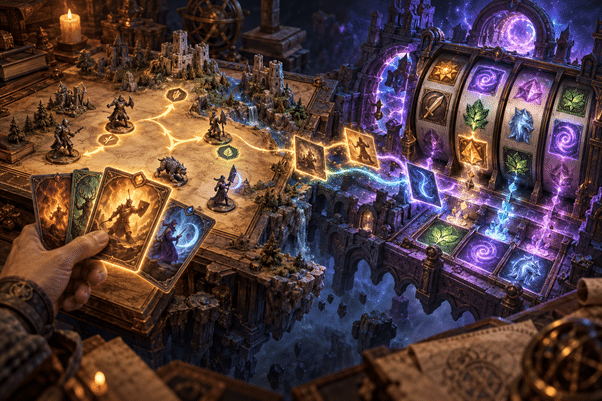
A three-choice reveal, a matching trigger or a chain of escalating effects can feel immediately familiar to a Hearthstone player. Digital card games and online slots sometimes draw on the same visual vocabulary: concealed information, sequential resolution, accumulating numbers and dramatic reveals.
That overlap is easy to overstate. In Hearthstone, randomness often feeds into a decision that changes the competitive state of the game. In a conventional slot, the wager is resolved according to a predefined probability and payout model. The similarity may be visible; the degree of control is a separate question.
Familiar presentation can hide very different decision structures
Someone browsing online slots Ontario may encounter pick screens, matching symbols, cascades and multipliers that resemble systems used in digital card games. ToonieBet, operated in Ontario by Canadix Limited under an iGaming Ontario agreement, offers more than 3,000 casino games from providers including Pragmatic Play, Hacksaw Gaming and Nolimit City.
The useful comparison begins with what the player can actually influence after the random event occurs.
In Hearthstone, chance can determine which cards or units become available, yet the player may still decide whether an option fits the current board, resource position or future plan. A slot interface can also present several concealed choices, but its rules must establish what those choices do mathematically.
A selection might switch between different feature modes. It might alter volatility. The visible options might also share the same underlying distribution. Without the rules, the interface alone tells us very little.
Discover is random generation followed by a consequential choice
Discover makes that separation unusually clear.
The game generates three eligible cards, after which the player chooses one. That choice can change subsequent turns because its value depends on context: current resources, board position, deck composition and the opponent’s likely responses.
A pick-style slot bonus can mimic the same sequence visually, with hidden alternatives followed by a reveal, but that does not establish an equivalent decision.
The underlying questions are different. Does selecting one object instead of another change the probability distribution? Are rewards assigned before the selection? Do the options lead to separate features? Does the choice alter expected return or merely presentation?
There is no universal answer. Treating every pick bonus as predetermined would be as careless as assuming every pick screen contains a strategic decision.
Tavern Refresh is a resource decision; a spin is a wager
Battlegrounds Refresh provides a stronger example of why superficially similar actions can have different economic meaning.
Refreshing the Tavern produces another random set of offers, but the action consumes an in-game resource. That resource could have been used to buy units, improve the board or support another plan. The player is weighing opportunity cost inside a competitive system.
A slot spin is not the same kind of reroll. It begins another monetary wager.
Triples show the difference from another direction. In Battlegrounds, players can intentionally acquire matching eligible units and work toward combining three copies into a stronger version. The result affects board strength and opens further decisions.
Slots can also use matching symbols to activate payouts or features, but the configuration is ordinarily generated by the game’s random mechanism and evaluated under its paytable. Recognizing what the pattern means does not make the next pattern more likely.
Cascades resemble combos because both unfold in stages
Cascading slot features can look especially familiar to players used to digital-card-game effect chains.
A winning group of symbols may disappear, replacements fall into the empty positions and the new arrangement is evaluated again. Some designs increase multipliers as successive winning cascades continue.
Hearthstone also resolves effects sequentially, but the origin of the sequence can be very different. A card-game chain may depend on deck construction, cards deliberately selected, action order and the board that the player has already built.
A conventional slot cascade is governed by the title’s payout and symbol-generation rules. The sequence may be revealed one step at a time, but the animation does not supply a tactical ordering decision unless the game explicitly documents one.
Multipliers create a similar visual resemblance. Increasing a minion’s statistics changes its competitive properties and may affect later choices. A slot multiplier changes the arithmetic used to calculate a prize. The numbers rise in both cases, but they are doing different jobs.
Gaming knowledge does not become gambling expertise
A Hearthstone player may already understand random offers, conditional triggers, scarce resources and chained resolution. That background can make certain interfaces easier to read.
It does not provide predictive information about the next slot result.
This boundary is one reason regulators scrutinize gambling interfaces that imply more control than the player actually has. British rules restrict features that create an illusion of control and prohibit celebratory audiovisual treatment when the return does not exceed the stake.
The issue is not animation itself. It is whether the presentation accurately reflects the financial result.
A dramatic sequence in a strategy game may represent an advantage created partly through earlier decisions. A visually similar sequence in a slot can still finish with a net loss.
Gambling therefore should not be framed as a natural extension of digital-card-game skill. In Ontario it is restricted to adults 19 and over, and it carries financial risk and should not be treated as a source of income. Spending limits, breaks and self-exclusion tools are appropriate safeguards, and ConnexOntario offers free, confidential support at 1-866-531-2600.
The most revealing comparison is not whether Hearthstone players recognize the screen. It is whether the system gives them a consequential decision after the randomness appears.
Submit your Top 500 Legend Build, be seen by thousands of people!