
What Hearthstone’s Digital Format Lets Its Cards Do
Hearthstone card displayed on screen

Playing a Hearthstone card gives the game an instruction. A minion enters the board, a spell resolves, or an effect changes an existing rule. The software carries out the action and records its consequences. Because those instructions are implemented in the game itself, a card can change both the board and the rules governing play.

Game director Tyler Bielman addressed that relationship when GameSpot asked about a physical Hearthstone game in February 2026. He explained that translating it into physical cards would sacrifice features fundamental to the experience. Different game mechanics either lend themselves well or poorly to functioning on a screen or with physical cards. Mechanics that require frequent searching of a deck would quickly become tedious in a physical version, while games that require physical feats, such as balancing the cards, are very tricky to implement digitally.

Of course, some games work very well in both the physical or digital versions, and some games blend the two by using a physical deck while still incorporating many of the advantages of digital play. In online live dealer blackjack, a dealer hosts the card play while participants make decisions remotely. Numbered cards carry their face values, picture cards count as ten, and an ace can count as one or eleven. Players can take another card or stand with their existing hand, just as they can in the physical version.

The issue with Hearthstone, however, is that it has too many mechanics that depend on things that are either slow for a human to check, or would involve information the players shouldn’t have access to, such as the order of the deck. Even so, understanding online blackjack can offer insights into how the digital format works and why it flows in different ways from a physical card game.

The digital format connects a card’s written instruction to the system that applies it. A rule can affect deck construction before a match starts, or change the state of the board once a card is played. Those are different points in play, but both require the game to recognize the card’s instruction and enforce the resulting rules. Similarly, when blackjack is programmed, developers have to think about how the software reveals the cards, how it handles pauses and play input, and what the structural implications of certain decisions are.

Rules the game can apply automatically

Escape from Violet Hold provides a concrete account of that design freedom. In a July 2026 interview with Shacknews, designers Cora Georgiou and Edward Goodwin discussed rule exceptions involving deck construction and minion placement. The expansion included minions that could be played on either side of the board, extending the usual relationship between playing a minion and placing it among your own units.

A card’s location is part of its meaning in Hearthstone. The board distinguishes your minions from the opponent’s, and card text refers to those relationships through terms such as “friendly” and “enemy.” Friendly and enemy describe a relationship to the player who controls the effect, rather than a permanent label printed on the minion. Giving a minion a choice of placement changes which side receives its effect. The software then applies the appropriate relationships. The decision belongs to the player; the game handles the resulting changes to the board.

Deck construction offers another kind of rule interaction. Hearthstone normally allows two copies of a non-Legendary card and one copy of a Legendary card in a constructed deck. Violet Hold’s rule exceptions reached those limits too. The effect begins with the list a player can build before the opening hand is drawn. It therefore needs to work with the deck-building system, not simply produce an animation during a match. The deck-building interface has to recognize the exception as part of a valid list.

The same interview discussed Mug’Zee as a card with two distinct forms. Georgiou described one form reducing the cost of the first minion played in a turn by two mana, the resource spent on playing cards, and another doubling Battlecries, effects that trigger when a card is played from the hand. The distinction involves timing as well as a number on a card: the game has to identify the relevant play and apply the effect when its conditions are met. The digital space meets these challenges well.

A new rule needs a readable action

Georgiou explained that playing minions on the opposing board required engineering and interface capabilities the team had not previously built. Writing a new effect was only part of introducing it. The game also needed a way for players to select and understand the action.
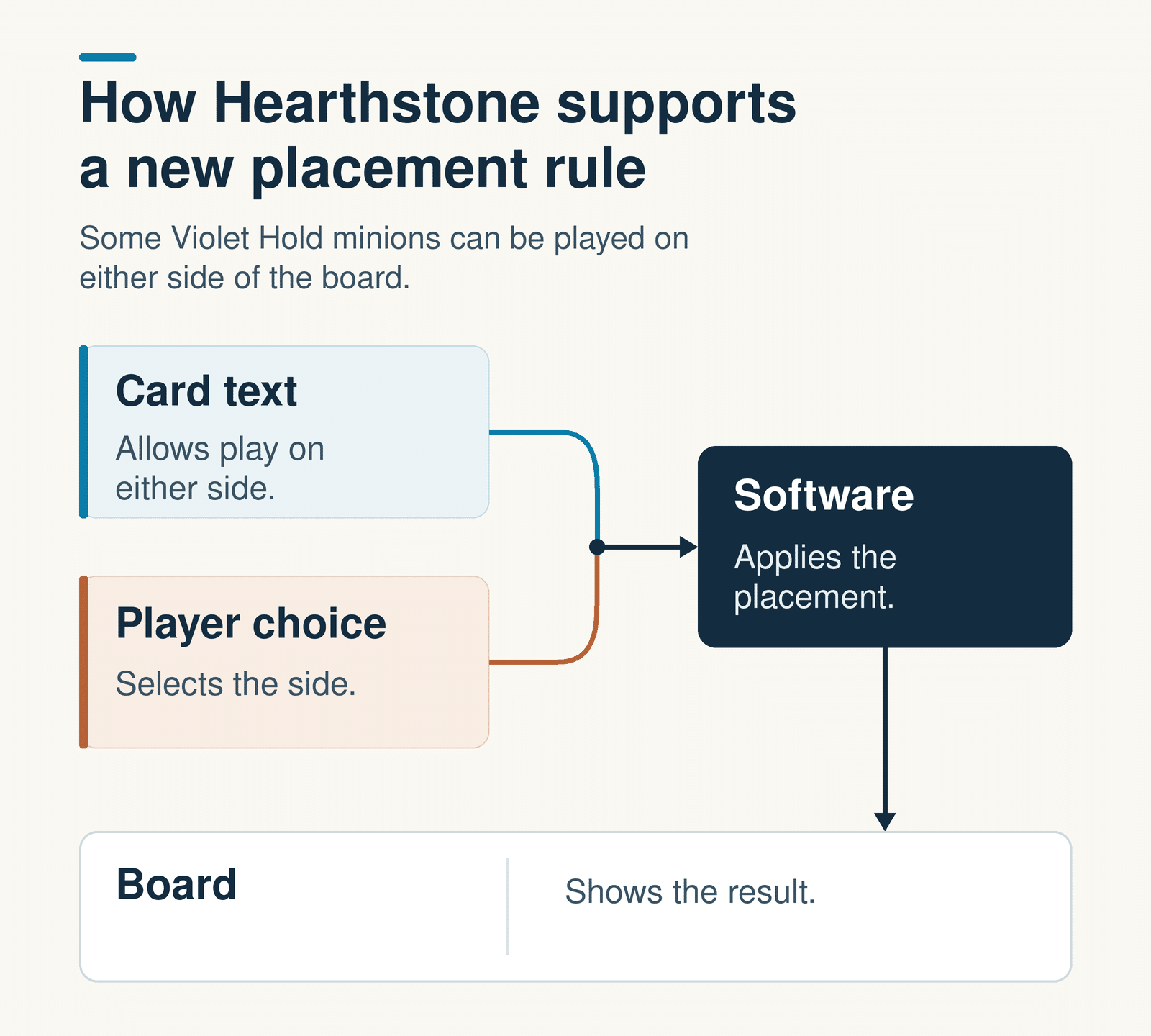
Card text and choice determine placement

Card text states what an effect does, while the interface presents how to use it. A board with two sides carries information about who controls its units. Allowing a placement choice changes how players interact with that familiar arrangement. The controls need to express the new permission clearly, so players can understand the available action through the board they already know.

Georgiou said the engineering and interface work created tools the team could reuse. That gives an unusual card a significance beyond its own text: supporting it can expand the set of actions available to designers.

What a physical version would need to preserve

Bielman’s February comments concerned the experience that those systems collectively create. Physical card games already express complex rules through written effects, components, and agreed procedures. Hearthstone’s software handles the execution and record-keeping within its existing format. A physical adaptation would need its own treatment of those tasks, and that treatment would affect the pace and feel of play.

Bielman did not rule out every possibility of a physical game ever existing. His concern was preserving what makes Hearthstone distinctive across formats. The cards’ characters and artwork would represent only part of that identity. Its playable identity also includes how actions become effects, how those effects are tracked, and how players see the resulting changes.

A card that changes an established action can require work on the controls and the rules the program applies. The opposing-board mechanic makes that connection visible: its written permission became playable when the game acquired the tools to support it.

Submit your Top 500 Legend Build, be seen by thousands of people!

Written by

The author didnt add any Information to his profile yet